Carry-On Weight Limits Explained (2026): Airline Rules & Tips
You’re at the check-in counter, and everything seems fine—until your carry-on goes on the scale. It’s heavier than allowed. Now you’re shifting items between bags or paying to check it at the last minute.
Carry-on weight rules can be confusing because not all airlines treat them the same. Some don’t mention weight at all, while others enforce strict limits. Let’s break it down so you know what to expect before you get to the airport.
Do Airlines Have Weight Limits?
Yes—but not always.
Some airlines clearly define a carry-on weight limit, while others don’t specify one at all. Instead, they expect you to handle your bag yourself and store it safely in the overhead compartment.
So even when there’s no official number, there’s still an unwritten rule:
- If you can’t lift it, it’s too heavy
That’s why weight limits can feel inconsistent. The rules depend heavily on the airline and region.
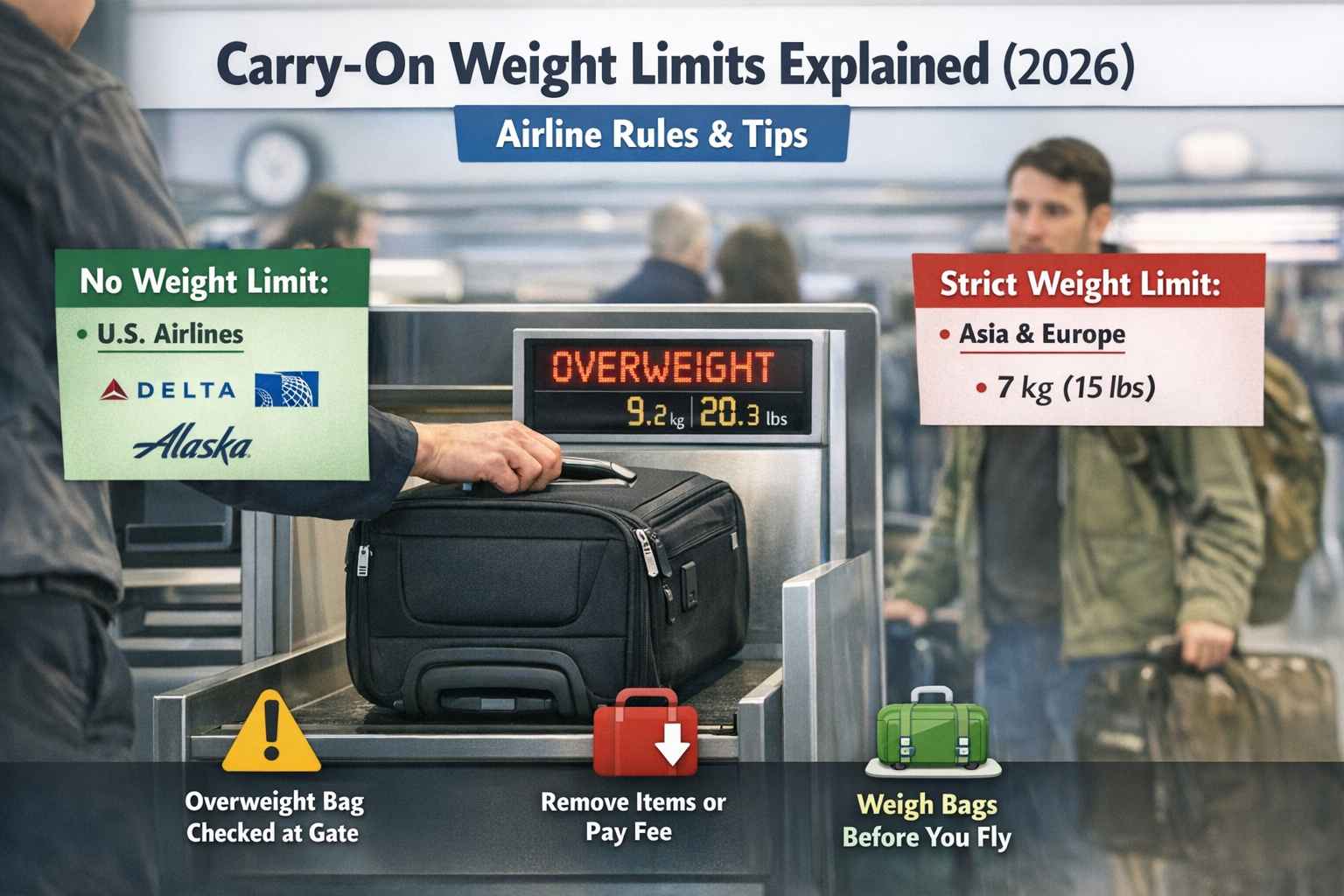
Airlines With NO Weight Limit
Many U.S. airlines don’t publish a strict weight limit for carry-on baggage.
Examples include:
- Delta Air Lines
- United Airlines
- Alaska Airlines
These airlines focus more on:
- Bag size
- Whether it fits in overhead storage
As long as your bag fits within the allowed dimensions and you can lift it, you’re usually fine.
Real-world example:
A slightly heavy suitcase may pass without issue on a U.S. airline if it fits in the bin and doesn’t slow down boarding.
Airline Weight Limit Examples
Airlines With Strict Weight Limits
Airlines in Asia and Europe are often much stricter about carry-on weight.
Typical limits:
- Around 7 kg to 10 kg (15–22 lbs)
Examples:
- Many Asian carriers (like AirAsia or Singapore Airlines)
- European airlines (especially budget carriers)
These airlines may:
- Weigh your carry-on at check-in
- Recheck it at the gate
- Enforce limits consistently
Important difference:
Even if your bag meets size requirements, it can still be rejected for being too heavy.
Why Weight Limits Exist
Weight limits aren’t just about rules—they’re about safety and efficiency.
Safety
Overhead bins have weight limits. Heavy bags:
- Can fall and cause injury
- Are harder to secure properly
Boarding Speed
Heavy or bulky bags slow down boarding. Passengers take longer to lift and adjust them.
Aircraft Balance
On some flights, especially smaller aircraft, weight distribution matters more.
Airline Business Model
Budget airlines use stricter rules to:
- Control cabin space
- Encourage paid baggage options
What Happens If Your Bag Is Overweight
If your carry-on exceeds the weight limit, here’s what usually happens:
At Check-In
- Your bag may be weighed
- You may be asked to remove items
- Or pay to check the bag
At the Gate
- Staff may spot-check bags
- You could be asked to place it on a scale
- If overweight, it may be checked immediately
Onboard
In rare cases:
- Crew may intervene if a bag is clearly too heavy to lift safely
Common scenario:
Travelers assume weight won’t be checked—but on stricter airlines, it often is.
Tips to Stay Within Limits
Here’s how to avoid problems before you reach the airport.
Weigh Your Bag at Home
Use a luggage scale or regular scale to check weight before leaving.
Pack Heavier Items in Personal Item
Items like:
- Electronics
- Books
- Chargers
can go in your personal item if allowed.
Choose Lightweight Luggage
Some suitcases are heavier than others—even when empty.
Switching to a lighter bag gives you more room within the weight limit.
Follow the Strictest Airline
If your trip includes multiple airlines, always follow the lowest weight limit.
Avoid Last-Minute Packing
Overpacking often leads to overweight bags. Plan your packing in advance.
Traveler Insight
From experience, carry-on weight checks depend a lot on where you’re flying.
In the U.S., weight is rarely checked. As long as your bag fits in the overhead bin, you’re unlikely to face issues.
In Europe, especially with low-cost airlines, checks are more frequent. Staff may weigh bags at the gate, not just at check-in.
In Asia, enforcement is often the strictest. I’ve seen passengers asked to repack their bags right at the counter if they exceed the limit—even by a small amount.
One thing that stands out is how inconsistent it can feel. A bag accepted on one flight might be flagged on the next, especially on connecting routes.
Compare Airlines
FAQs
Do all airlines have carry-on weight limits?
No. Some airlines specify limits, while others rely on your ability to handle the bag.
What is the typical carry-on weight limit?
Many airlines set limits between 7 kg and 10 kg, especially outside the U.S.
Do U.S. airlines check carry-on weight?
Usually no, but your bag must still be manageable and fit in the cabin.
What happens if my carry-on is overweight?
You may need to remove items or check the bag for a fee.
Can I move items to my personal item?
Yes, if your airline allows a personal item and it stays within size limits.
Is carry-on weight checked at the gate?
Sometimes, especially on budget or international airlines.
Knowing how carry-on weight limits work gives you a clear advantage. Pack smart, check your airline’s rules, and you’ll avoid last-minute surprises before boarding.
Explore full carry-on size guide.